OFF THE RECORD #119
Power Players and Bargain Hunters - National Sale Delivered For All
Read moreHawaii: The Champion Who Conquered Two Worlds
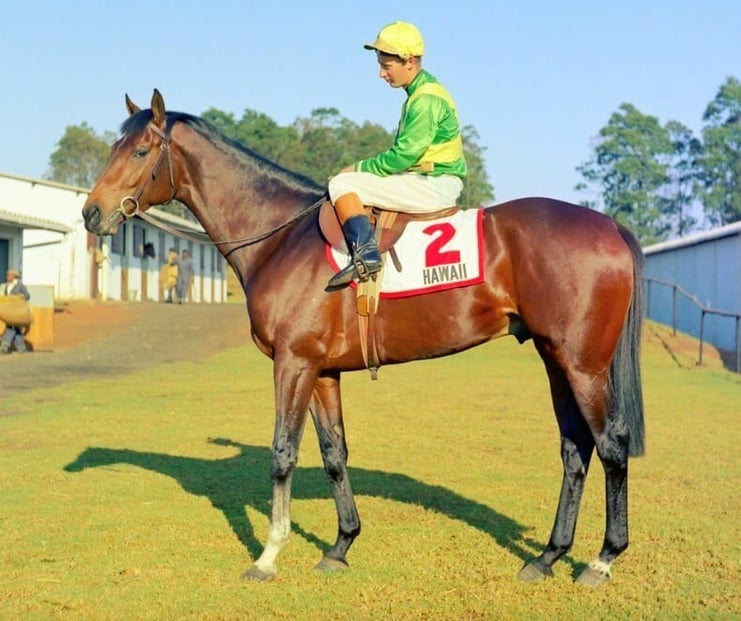
Above: Hawaii, globetrotting star (image: supplied)
Next Saturday marks the 56th running of the Grade 2 Hawaii Stakes over 1400m on SA Derby Day at Turffontein, a race inaugurated in 1970 – the same year the legendary South African champion after whom the race is named was retired to stud in Kentucky, bringing the curtain down on a glittering international career.
Hawaii’s story begins at breeder Archie Dell’s Platberg Stud near Colesberg on Saturday, 5 September 1964, a crisp spring morning that saw his dam, Ethane, deliver yet another in a long line of high-profile winners.
Hawaii was sired by Dell’s 1963 Italian import Utrillo II, who was mated to the proven speed influence of his prolific broodmare Ethane in an effort to give the new stallion a strong foothold at stud. At 17, she’d already produced champion racers in Just Spirit (Fair Judgement) William Penn, Entrance and Courtella (all by Netherwood).
The young colt was raised tough – like most Karoo-breds at the time – growing up on open, dry and wind-swept plains dotted with grasslands, shrubs and small, rocky hills. Yet his handsomeness and natural class shone through his woolly exterior long before he was sent to the Sale of Thoroughbred Yearlings, staged by the Witwatersrand Agricultural Society in March 1966.
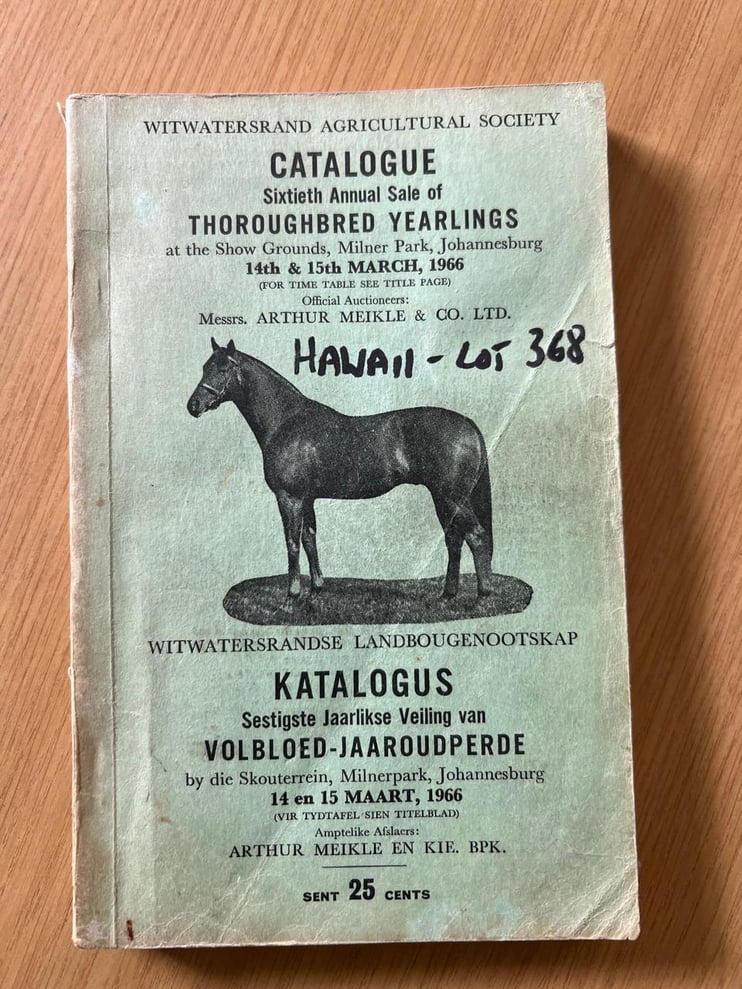
Above: The 1966 Yearling Sales Cataloge (image: supplied)
The sale was held at the old Milner Park Showgrounds on a slope in Braamfontein, Johannesburg – then home to the spectacular Rand Easter Show and just a stone’s throw from the newly built Johannesburg Planetarium – an apt setting for a future star about to make his first public appearance in the auction ring.
Accomplished trainer George Azzie was a member of the three-man panel tasked with identifying the best-conformed yearling on the sale. Hawaii was the unanimous choice, with breeder Dell receiving the rosette for ‘Champion Show Yearling’.
Azzie himself was taken by the beautiful colt, even more so because his brother, Joe Azzie, had trained Hawaii’s grandam Ethyl. Azzie was the first and last to raise his hand in the auction ring. He secured Hawaii for 4,300 guineas (about R9,000), the third-highest price on the day, on behalf of his biggest patron, the American metals magnate Charles Engelhardt.
Hawaii arrived at Azzie’s Wood Ditton House in the village of Newmarket, Alberton, where his grandson Michael Azzie, then just nine years old, recalled this week: “Hawaii was checked into stable 32, alongside Caradoc and Prize Bell, both top performers on the track.”
There were several other promising runners in a yard that had already tasted Durban July success with Preto’s Crown (1955) and Numeral (1964). George Azzie was at the height of his powers, operating from a suitably picturesque establishment.
“My grandfather employed two gardeners. There was an exquisite rose garden and perfectly manicured lawns. We visited the stables and the work tracks often, almost daily once Hawaii began racing. He was a striking bay with three black socks, grey on his off fore. He looked quirky when he trotted but had a beautiful, flowing action when he broke into a canter.”
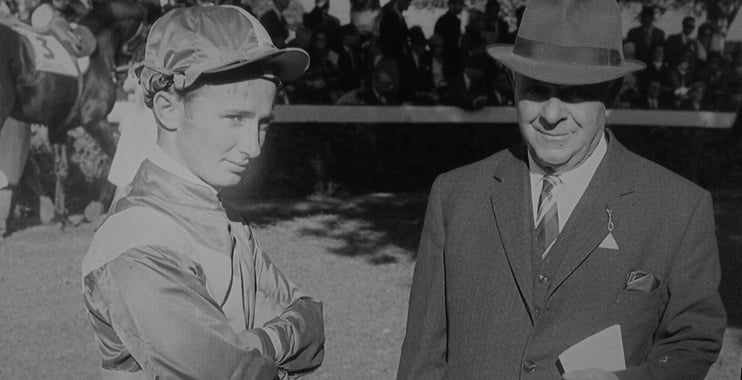
Above: George Azzie and Raymond Rhodes (image: supplied)
George’s stable jockey was the supremely talented Raymond Rhodes, who had won his first July on Numeral at just 20 and, by 22, was already a master tactician in 1966. In support was promising apprentice Martin Schoeman, a public favourite thanks to his unmistakable mane of flashy blonde hair.
Rhodes, now aged 81 and still walking on the treadmill every morning, has fond memories of Hawaii’s early days. He recalled: “When we started putting Hawaii through his paces, he didn’t seem to enjoy the sand, but he was a different kettle of fish on the grass. They opened the grass track at Newmarket on Thursdays and, one morning ahead of his first run, he completed 800m in under 46 seconds without me lifting a finger.”
Azzie had an inkling he had something special, and it was confirmed when Hawaii won his well-backed debut in a Maiden Juvenile Plate over 800m at Gosforth Park on 12 November 1966, coming from a slow start to score by seven lengths.
“I hardly moved on him that day,” Rhodes recalled. “Afterwards we started working him with top older horses and he toyed with them. Martin and I usually worked together in different galloping pairs. Hawaii would give Martin’s mounts a few lengths’ start – he was already that good at two.”
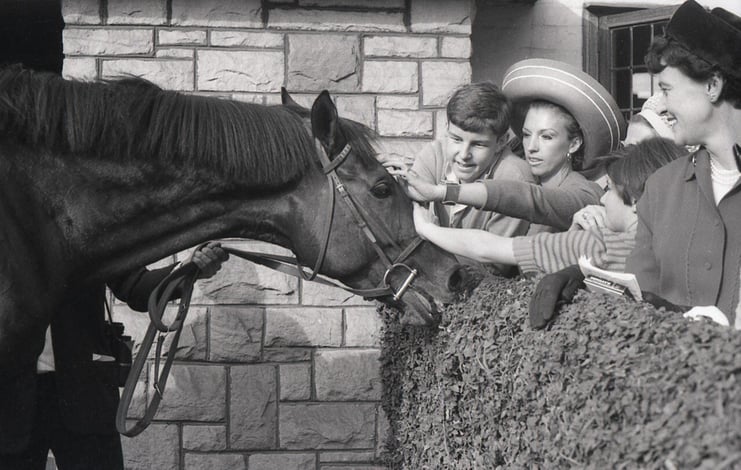
Above: Hawaii nips at the hedge in the winner's enclosure, with his farrier Jannie van der Walt (left) and Elizabeth Rhodes looking on (image: supplied)
Hawaii won his first four starts by a combined margin of 25 lengths, including the Listed African Breeders Stakes over 1400m at Greyville on 27 May 1967. Then, in a surprise reversal, he suffered defeat a week later in the Grade 1 Champions Nursery over the same trip.
Rhodes reflected: “He wasn’t quite at ease when he raced at Greyville and I was never sure why. He sweated more than usual and became a bit excitable. Perhaps the walkways and the track were too cramped for him. That said, I think I may have misjudged things in the Nursery when we got going too late.”
Azzie silenced any doubts about Hawaii’s class when, 17 days later, he stepped him out over 1200m in a B Division handicap at Clairwood.
Bloodstock authority Robin Bruss wrote in the Sporting Post: “The handicapper had set him an impossible task. He was a two-year-old and had to concede 20 lbs to Young David, a five-year-old winner of six races. Hawaii was 38 lb worse off than weight-for-age, yet still won by six lengths. This is equivalent to an 18-length beating of older horses. What had just happened? Horses don’t do this. It was the emergence of a superstar.”
In the next 11 months – July 1967–June 1968, Hawaii won a further nine races on the bounce, by a combined margin of 33 lengths. He became the first – and remains the only – horse to win all three Grade 1 Guineas across three regions: the then Royal Reserve Benoni Guineas, the Cape Mellowwood Guineas at Milnerton, and the SA Guineas at Greyville.
By the time the 1968 Rothmans Durban July Handicap came around, Hawaii was already a national equine celebrity, and a then-record crowd of nearly 55,000 racing fans packed the course on Saturday, 6 July in the hope of witnessing a sensational victory by the young star.
Hawaii was sent off a 15–10 favourite for the then 2100m contest, but the fairytale victory never materialised. As a three-year-old, he carried 55.5kg from a wide draw of 18 against seasoned older rivals, and the effort told in the closing stages. Inside the final 200m he was run out of it by the 33–1 outsider Chimboraa, his half-brother William Penn, and Smash And Grab – beaten just two lengths.
Azzie felt Rhodes had made a crucial error at the top of the straight by switching out for a run, but the jockey stood by his ride. “I made my move off the false rail and Hawaii ran right up to the leaders before becoming one-paced. I just don’t think he stayed the distance that day.”
Robin Bruss, however, felt Hawaii had enhanced his reputation in defeat: “The handicap weights told a story. The 33–1 winner Chimboraa was a five-year-old carrying 98 lb. Hawaii met him on 23 lb (10 lengths) worse terms than weight-for-age and therefore ran a full eight lengths better race than the winner.”
Just two weeks later, Hawaii set the record straight, winning the Grade 1 Clairwood Winter Handicap over 1800m with ease from Peter Beware, while his July conquerors Chimboraa and William Penn trailed more than eight lengths behind.
At this point, owner Charles Engelhardt advised Azzie that he believed Hawaii was good enough to take on the best in the United States, and rumours soon began to circulate that the champion would be departing South African shores.
Hawaii suffered only the third defeat of his career in the Grade 1 Champion Stakes, his first outing as a four-year-old on 14 August 1968. It also marked his third loss in five starts at Greyville, where he was collared in a stirring duel by William Penn. Rhodes again pointed to stamina: “He went a length clear, but his lack of staying power allowed William Penn to come back at him.”
The decision to export Hawaii was now final, and Michael Azzie recalled: “Granddad was understandably disappointed, but Mr Engelhardt explained that he wanted to prove a South African-bred could hold his own in the United States, and that he had a future at stud. He promised to continue supporting the stable by sending us two runners per year, including some of Hawaii’s progeny.”
A large crowd gathered at Turffontein on Thursday, 10 October 1968 – a public holiday – to witness Hawaii’s farewell run in the Grade 2 Transvaal Champion Stakes over 1400m. He duly won in his customary easy fashion, greeted by a crescendo of applause.
Hawaii was paraded on the course proper, with his trainer, jockey and groom waving to the crowd. They were joined by horse lover Juliet Prowse, the dancer and actress who had made a name for herself in the United States, appearing alongside legends such as Frank Sinatra and Elvis Presley.
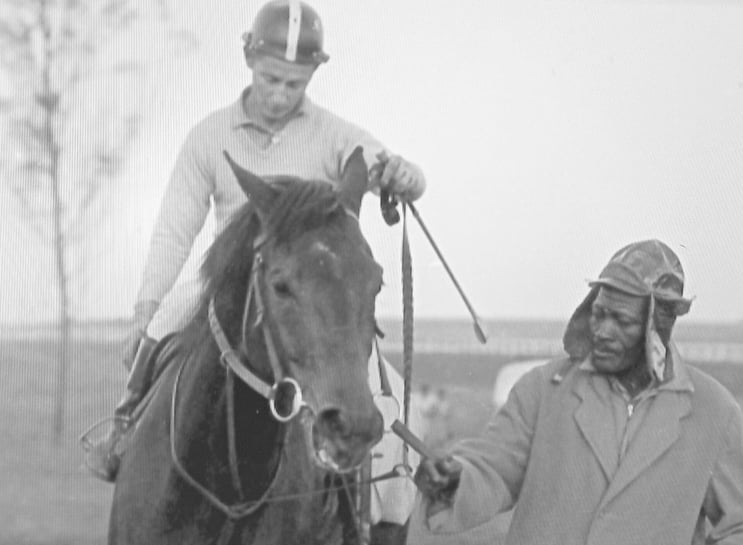
Above: Hawaii (Rhodes) in work at Newmarket, alongside his groom, Morris (image: supplied)
Azzie recalled: “Hawaii’s groom, Morris (‘Maja’), was a smart gentleman who grew up in what was then Rhodesia and had worked with a number of the stable’s top horses, including the 15-time winning sprinter Melrose. Morris always dressed up for races in a jacket and tie, topped off with a fedora. He loved his work and was immensely proud of Hawaii.
“After the Turffontein farewell, Morris informed my grandfather that he was calling it a day. Saddened at the loss of his champion, he decided to retire and returned to join his family north of the Limpopo.”
Rhodes, who rode Hawaii to 15 wins in 18 starts, concluded: “What a horse Hawaii was. I was the only jockey in South Africa to have had the pleasure of riding him in a race. That was a true honour and privilege.”
***
Hawaii’s South African chapter had closed, but greater tests lay ahead. In the United States, he would be asked to prove that a champion from the southern tip of Africa could match the best on the world stage.
Hawaii was required to spend 60 days in quarantine, confined to his stall, and had lost condition by the time he was released. He joined the stable of Mackenzie ‘Mac’ Miller, who allowed him time to recover before building him up for his US debut at Belmont on 3 June 1969. He duly pulverised the opposition, winning an allowance race over 1400m by seven lengths.
Two weeks later, Hawaii was tested on a dirt track for the only time in his career. He showed little in a mile allowance, finishing sixth, beaten 6.75 lengths. It was the only occasion in 10 American starts that he failed to finish in the money, lending some credence to Raymond Rhodes’ earlier assessment that he was not the same horse on sand when worked at his old home track at Newmarket.
Hawaii next captured the Stars and Stripes Handicap over 1700m at Arlington Park, before finishing third behind twice American champion turf horse Fort Marcy in the Tidal Handicap over the same trip on a wet Aqueduct track.
Slow away in the Kelly-Olympic Handicap over 1800m at Atlantic City, Hawaii nevertheless finished “like a hurricane”, only to be pipped on the line in his second clash with Fort Marcy.
He would not be denied next time. Remaining in Atlantic City, Hawaii exacted emphatic revenge, defeating Fort Marcy by seven lengths in the United Nations Handicap over 1900m, before stepping up to 2400m to win the Sunrise Handicap and confirming himself as the real deal.
Hawaii’s defining moment came on 18 October 1969, when he started favourite for the Grade 1 Man O’ War Stakes over 2400m at Belmont Park. Sitting a few lengths off the pace, he circled the field in a sweeping run before drawing clear to win by 2.25 lengths under hands and heels from Hall of Fame jockey, Jorge Velasquez.
For the occasion, Engelhardt flew George Azzie to New York, and Michael Azzie recalled: “He had kept his word. My grandfather enjoyed the holiday of a lifetime and got to lead Hawaii into the winner’s enclosure.”
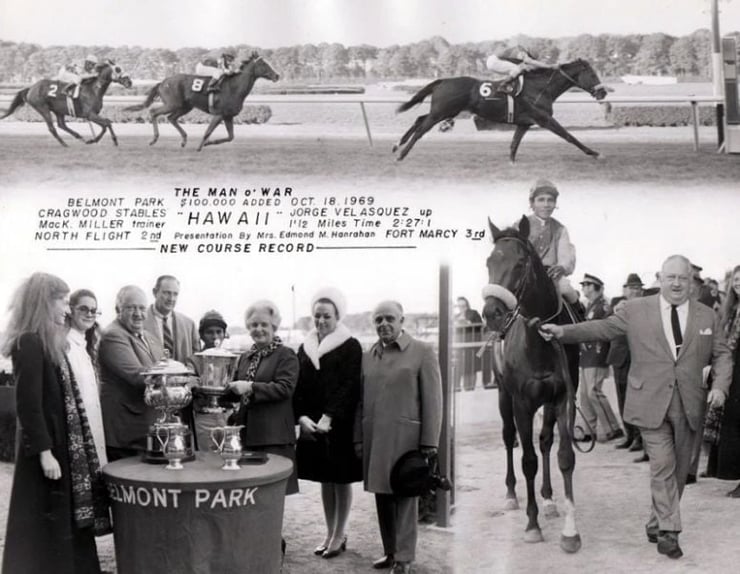
Above: Hawaii wins the Man O'War in October 1969. George Azzie was in the winner's enclosure with the connections (image: supplied)
Retired to stud at the prestigious Claiborne Farm in Kentucky in 1970, Hawaii was down the pecking order in the company of 17 other stallions from around the world, including Bold Ruler, Nasrullah, Damascus and Tom Rolfe. He always covered small books of mares, never had more than 25 foals in a crop, but his record and legacy speak volumes for his modest level of support at stud.
He sired 73% winners to runners, and an impressive 13% of his runners won Stakes Races, where the breed average is 3%. He sired 34 Stakes Winners who won 56 stakes races and they excelled on turf.
Hawaii’s son Henbit won the 1980 Group 1 Epsom Derby, a landmark achievement for a South African bred sire, and his daughter Sun And Snow won the Group 1 Kentucky Oaks. His influence stretched to the pedigree of the 2018 US Triple Crown winner and now in-demand stallion, Justify, specifically in both his male and female lines.
Robin Bruss succinctly captured Hawaii’s formidable achievements: “In winning the Man O’ War Stakes over 2400m, Hawaii laid the stamina ghost to rest. His record reads 21 wins from 26 starts, including two Grade 1 victories in the United States.
“He was tested for speed, stamina, character, toughness, soundness and durability across two hemispheres, two continents, seven cities and 12 different race tracks. With a Timeform rating of 131, the title of Champion Turf Horse in America, and a $1.2 million stud syndication, he established a global reputation for himself — and for South Africa.
“I am not sure if we will ever again breed a horse as good as this.”
With more than three months remaining before the 2025/6 South African racing season draws to a close on July 31, ...
Read more