OFF THE RECORD #119
Power Players and Bargain Hunters - National Sale Delivered For All
Read moreHorses, Power And The Figures Who Shaped History
Long before modern warfare was conducted through social media, motorcades and ballistic missiles, one animal carried leaders, explorers and statesmen with great dignity. Throughout history the horse has symbolised nobility, power and even salvation – an image that may offer a measure of escape as we struggle to see lasting solutions to the carnage unfolding around the world.
It carries darker undertones too, thundering through prophecy and myth – most famously in the biblical vision of the Four Horsemen of the Apocalypse. For some, this ancient image of the Four Horsemen may feel unsettlingly relevant to the world we see today.
Perhaps it is better to dwell on the horse’s more noble symbolism through history rather than allow darker imagery to draw us into fear and foreboding. Horses are no longer central to warfare or political power, but in politically volatile times such as these the mind may drift to the timeless image of a powerful figure on horseback.
Many of history’s most influential leaders were accomplished horsemen, and few figures better connect the modern world with the age of horse-borne leadership than Britain’s wartime Prime Minister, Sir Winston Churchill (1874-1965).
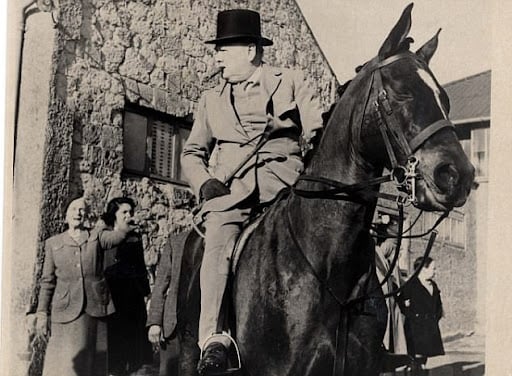
Above: Winston Churchill (image: churchill.org)
Young Churchill was a cavalry officer who rode with the 21st Lancers at Omdurman in 1898 and fought the Mahdist regime in Sudan. Horses were an integral part of military life in that era, and Churchill’s early experiences in the saddle helped shape the character of the statesman who would later guide Britain through its darkest hour.
Churchill considered horseracing to be an integral part of British tradition and culture, and frequently attended race meetings at Ascot and Epsom. The cigar-smoking Prime Minister was an enthusiastic owner himself and, fittingly, his best horse was the 13-time winner, Colonist II.
Churchill’s modern-day successor wouldn’t be expected to or capable of mounting a horse with resolve, let alone ride towards danger at the head of their troops, but there are many other horse-loving leaders who earned their place in history.
Queen Elizabeth II (1926 – 2022) had a lifelong passion for horses. An avid breeder and racehorse owner, she racked up 1600 winners and was a patron of the British Horse Society, the Fell Pony Society, and the Thoroughbred Breeders' Association. The Queen won 24 races at Royal Ascot and among her best was 1954 European Champion Aureole; the 1977 Oaks winner Dunfermline and 2013 Ascot Gold Cup winner, Estimate.
The first US President George Washington (1732-1799) was known as an exceptional horseman. He was in command when the US defeated Great Britain in the Revolutionary War. Washington was famous for his prowess in the saddle during battle, often on his favourite horse, Nelson.
Another American Founding Father, Thomas Jefferson (1743 –1826) was said to be a bold and fearless horse rider who rode almost every day during his presidency. He had a keen interest in Arabian stallions and breeding, kept a detailed journal on horse care and attended race meetings at a racecourse near the White House.
Ulysses S. Grant (1822 -1885), the 18th US President, led the Union Army to victory in the American Civil War in 1865 as commanding general. A legendary rider known for his ‘sensitive hands’, he rode his favourite horse, Cincinnati, during the American Civil War.
Theodore Roosevelt (1858 – 1919), suffered from asthma and took up horseback riding to boost his overall strength. He commanded the 1St US Volunteer Cavalry Regiment, nicknamed ‘The Rough Riders’, during the Spanish-American War in Cuba in 1898. In the early years of automobiles, Roosevelt declined an offer to own one and famously declared, “The Roosevelts are horse people”.
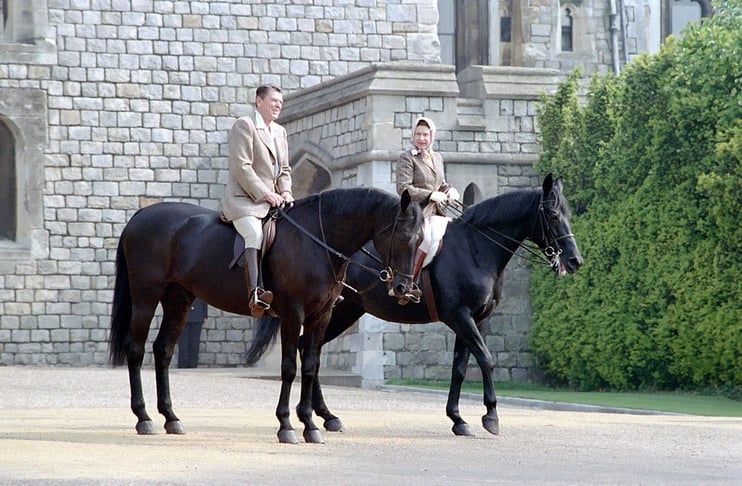
Above: Ronald Reagan and Queen Elizabeth II (Wikimedia Commons)
More recently Ronald Reagan (1911 -2004), was an active horse lover and rider whose out-of-office routine included daily riding and grooming at his farm, Rancho del Cielo. During his presidency, in 1982, Reagan once rode out at Windsor Castle with Queen Elizabeth II.
The current US President Donald J. Trump (1946- ), briefly flirted with racehorse ownership in 1988, when he spent a whopping $500,000 on a colt by Raise A Native. He named it ‘DJ Trump’ and was hoping to win the Kentucky Derby, but the young horse suffered leg problems and never made it to the track.
South African history – from whichever political perspective it is told – is rich in equine heritage. It begins, perhaps inevitably, with the much-loved or much-maligned Jan van Riebeeck (1619–1677), the first Commander of the Cape, who sailed into Table Bay from the Netherlands in 1652.
Soon after he settled in, Van Riebeeck requested horses to be sent to his new base for transport and expansion purposes. He is credited with introducing the first domestic horses to the Cape. The first to land were Javanese Ponies, who were used to the advantage of the Dutch ‘Kommando’s’ in skirmishes with the indigenous Khoikhoi people.
In later years, the ponies were mated with horses from Arabian and Persian origin and formed the foundation for uniquely South African breeds like the ‘Boerperd’.
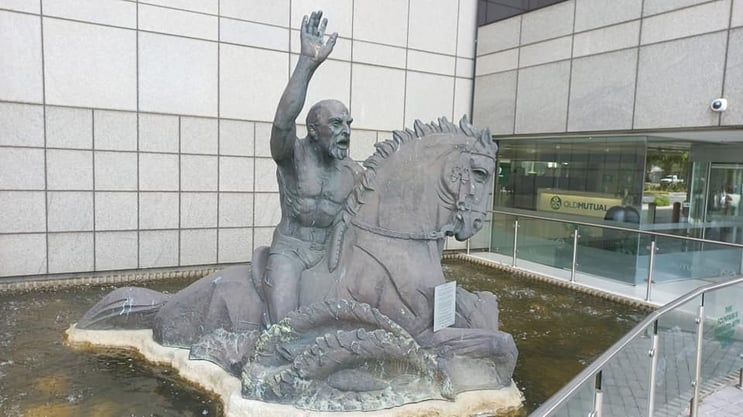
Above: Wolraad Woltemade statue at Old Mutual Building in Cape Town (image: supplied)
A remarkable, and historically verified story from early Cape history concerns the 65-year-old dairy farmer Wolraad Woltemade. He happened to be on horseback during a heavy storm in Table Bay on 1 June 1773, when he witnessed the Dutch East India Company ship De Jonge Thomas run aground.
The crew of the stricken vessel needed urgent assistance, with some sailors already diving into the stormy waters. Woltemade rode his horse, Vonk, into the surf to help. Time and again he braved the waves, returning seven times and rescuing two sailors on each occasion, who clung to the horse’s tail.
On his eighth attempt, however, with the ship close to sinking, panic took hold. Horse and rider were overwhelmed by desperate sailors, and all were lost to the ‘Cape of Storms’.
King Sandile ka Ngqika (1820-1878) was known as the ‘Warrior King’. He led the Xhosa nation against the British in a number of Frontier battles and his elite military unit was known for its exceptional equestrian skills.
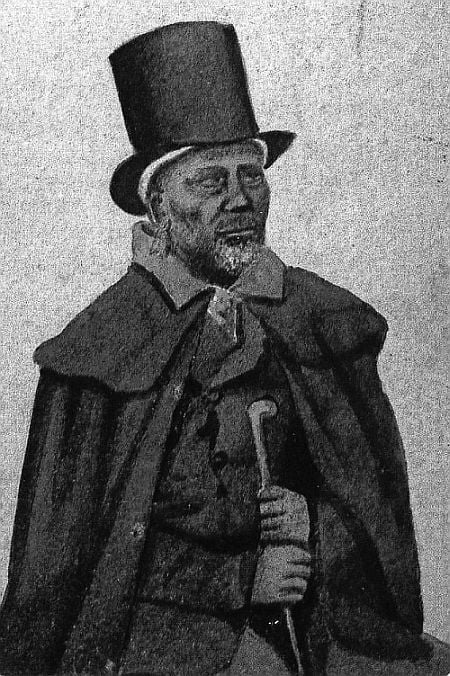
Above: King Mosoeshoe I (image: Mail and Guardian)
King Moshoeshoe I (1768–1870) was a seasoned leader and negotiator who founded the Basotho nation. He had a deep-seated and strategic relationship with horses that helped shape the kingdom of Lesotho. He valued horsemanship and recognised the importance of horses for transport, warfare and agriculture.
Moshoeshoe turned the Basotho into a nation of renowned horsemen and is honoured annually in March with horse racing events in the Kingdom of Lesotho, including the Ramela Foundation Race. Many of South Africa’s 20th-century trainers spoke with great respect of the Basotho who were employed as grooms – a tradition that has largely faded with urbanisation and the lure of better-paying opportunities.
One of the most revered leaders during the Second Boer War was General Koos De La Rey (1847 – 1914), who combined military strategy with horsemanship. He relied heavily on the mobility of his horses. His commando moved quickly across vast areas, often catching the British troops off guard. De La Rey’s trademark offensive was ‘Stormjaag’ (Storm Chase), involving a combination of surprise and fast-paced attacks.
Another Boer Leader who used horses to his advantage in battle was Louis Botha (1862 – 1919). He became the first Prime Minister of the Union of South Africa, and is commemorated through equestrian statues in Cape Town, Pretoria and Durban, which may or may not be standing at the time of writing.
Field Marshal Jan Smuts (1870 – 1950) was a skilled horseman whose commandos successfully employed guerilla tactics using well-trained horses in the Anglo-Boer War. Smuts was proud of the Boers’ upright style of riding, said to have suited their deeper saddles. Smuts’ favourite horse, Charlie, was killed in an ambush. A bone fragment of Charlie, and Smuts’ saddle, is displayed in the War Room of the Smuts House Museum in Pretoria.
In the late 20th century, the Afrikaner Nationalist Eugène Terre'Blanche frequently appeared on horseback as leader of the Afrikaner Weerstandsbeweging (AWB – Afrikaner Resistance Movement). He used horses to signify resistance, defiance and traditionalism. Terre’Blanche is remembered for his notoriety, and for once falling off his horse in front of a large crowd and media cameras during an AWB Parade in Pretoria in 1991, leading to worldwide ridicule.
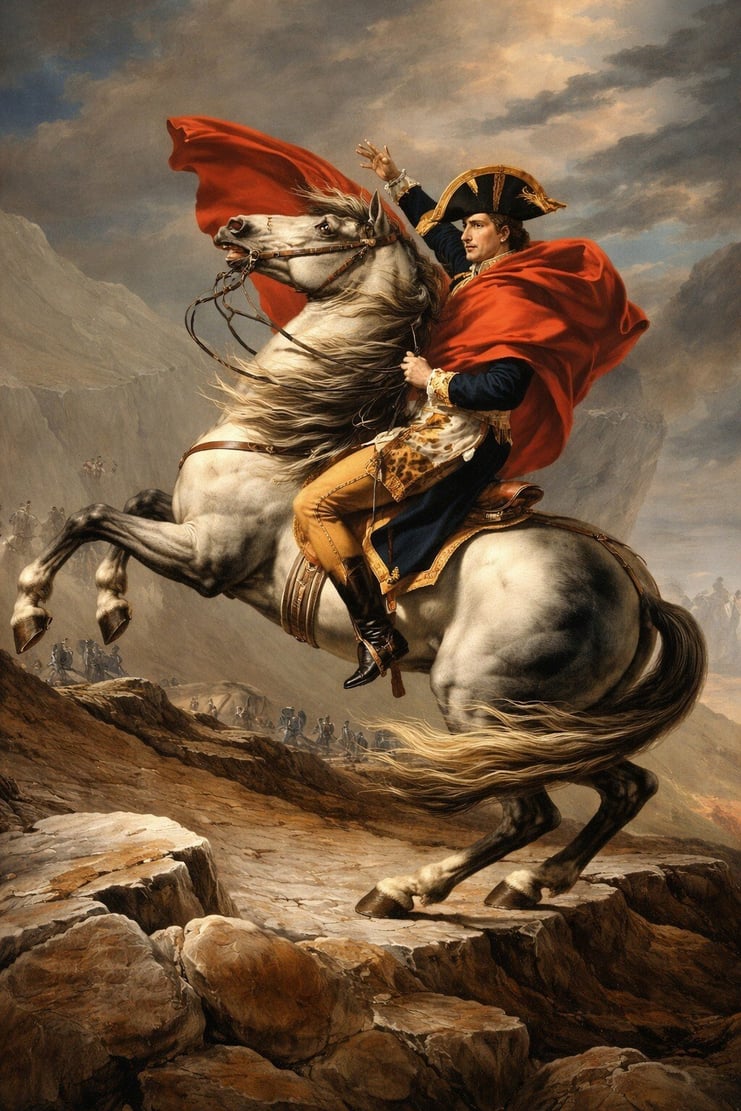
Above: Image of Napoleon and Marengo (image: Grok AI)
No account of statesmen, notable political figures and horses would be complete without mention of Napoleon Bonaparte (1761–1821), the legendary French general who rose to prominence during the French Revolution and led military campaigns across Europe from 1796 to 1815.
Napoleon was a consummate horseman who enjoyed a special bond with his powerful white stallion, Marengo, forged during battles including Austerlitz (1805) Jena (1806) and Wagram (1809). Marengo had all the qualities of a perfect war horse – speed, stamina, intelligence, and above all, great courage. He was a fearless and loyal companion and an indispensable asset to his rider.
When Marengo was captured by British Forces at the battle of Waterloo (1815) and shipped to England, he became a type of ‘war trophy’ – an equine celebrity. He was a symbol of heroism, strength and endurance who lived out his days with dignity in the care of the Grenadier Guards.
Sources:
Researchgate.net
Cambridge.org
South African History Online
Wikepedia.org
Biography of Chief Sandile Ka Ngqika: Key Role in Frontier Wars - Studocu
White House Historical Association
4theloveof-horses.com
With more than three months remaining before the 2025/6 South African racing season draws to a close on July 31, ...
Read more